
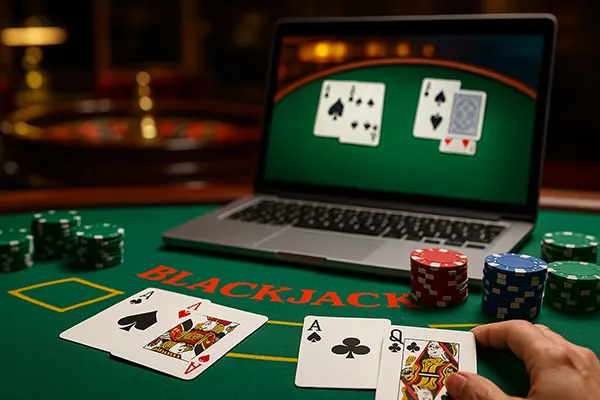
Evolution of Blackjack: From the Spanish “Veintiuna” to Modern Digital Variants
Blackjack has travelled a long historical path, evolving from an early Iberian card pastime into one of the most recognisable table games available in land-based venues and online environments. The transformation reflects changes in rules, technological adaptation and global interest, turning a once-regional activity into a structured game with defined strategies and numerous contemporary formats. This article explores the roots of the game, its development through European and American gambling cultures, and the technological shift that shaped the modern digital experience.
Early Origins of “Veintiuna”
The earliest reference to a game resembling blackjack appears in Spanish sources from the early seventeenth century. “Veintiuna”, meaning “twenty-one”, involved drawing cards with the objective of reaching a total closest to 21 without exceeding it. The rules described by Spanish writer Miguel de Cervantes suggest that aces could count as 1 or 11, establishing a familiar mechanic that remains central today.
Historical documents show that “Veintiuna” spread through Spain’s taverns and military gatherings, gradually adopting house rules that varied between regions. The game was simple to learn and quick to play, which contributed to its popularity among travellers and merchants. By the eighteenth century, the structure of “Veintiuna” was recognisable enough that other European gaming circles began incorporating similar concepts.
As cross-border trade and cultural exchange intensified, the Spanish version inspired adaptations in France and Italy. This expansion brought refinements in scoring and dealing practices, laying the framework for the next chapter of the game’s evolution.
Development Across Europe
In France, the game inspired “Vingt-et-Un”, which emerged during the reign of Louis XV. French aristocratic salons adopted the pastime, adding elements such as the dealer’s obligation to hit until a fixed total was reached. These structured rules made the game more predictable and strategic, attracting players interested in calculated decision-making.
The French variation reached Britain in the eighteenth century, where local establishments introduced side rules and additional betting options. Although the British public initially gravitated more towards card games like Faro, the foundations of the emerging twenty-one-style game continued to strengthen through gradual exposure.
By the time French immigrants brought the game to North America, it had acquired enough recognised characteristics to establish itself quickly in local gambling houses. This set the stage for significant rule standardisation and the formal creation of blackjack.
Transformation of Twenty-One into Blackjack
When twenty-one arrived in the United States during the nineteenth century, gambling venues introduced promotional bonuses to attract players. One of these bonuses awarded a premium payout for a hand consisting of an ace and a black jack. Although the bonus itself later disappeared, the name “blackjack” remained and became universal.
American gambling establishments formalised rules that are now globally associated with the game: the dealer hits on 16, stands on 17, and players may hit, stand, double or split depending on their cards. These rules created a consistent framework that made blackjack accessible yet highly strategic.
By the mid-twentieth century, blackjack’s popularity increased rapidly due to published works on card counting and probability analysis. Researchers identified that optimal play could reduce the house edge significantly, which encouraged both casual players and mathematical enthusiasts to approach blackjack as a game of strategy rather than pure chance.
The Rise of Professional Strategy
In 1962, Edward O. Thorp published “Beat the Dealer”, a book that applied statistical analysis to card distribution and demonstrated that disciplined strategy could influence long-term outcomes. The publication marked a turning point in blackjack theory and public perception.
Casinos responded by introducing multi-deck shoes and frequent shuffling to counter card counting. Despite these measures, blackjack remained appealing due to its mathematically grounded decision-making process. Strategy charts, probability tables and simulations contributed to its reputation as a skill-influenced game.
The growing community of professional players fostered tournaments and competitive events, solidifying blackjack’s cultural status. This environment encouraged further experimentation and the eventual transition into digital formats.

Blackjack in the Digital Era
The arrival of digital gaming brought significant change to blackjack. Online environments allowed players to engage with multiple rule variations, including European, Atlantic City, Vegas Strip and Double Exposure formats. These versions maintained core mechanics but introduced differing dealer rules, deck counts and payout structures.
Technological improvements enabled the development of live-dealer blackjack, combining real-time video streaming with on-screen interfaces. This format provided structured interaction with professional dealers and followed authentic rules, appealing to players seeking realism without visiting physical venues.
Modern digital blackjack in 2025 includes advanced features such as side bets, multi-hand tables and responsible gaming tools. Regulatory frameworks ensure fairness through certified random number generators, while professional oversight maintains transparent playing conditions. The variety and accessibility of blackjack continue to expand as software developers refine user experience and integrate cross-device compatibility.
Contemporary Innovations and Future Direction
Current versions of blackjack incorporate features designed to balance tradition with modern expectations. Side bets such as Perfect Pairs and 21+3 offer optional risk without altering the primary game. Meanwhile, statistical assistance tools enable players to follow recommended strategies more accurately.
Mobile optimisation allows blackjack to run smoothly on smartphones and tablets, ensuring stable performance and clear visual presentation. Developers increasingly focus on efficiency, security and compliance with updated licensing requirements to meet user expectations in 2025.
Future developments are likely to concentrate on personalisation, expanding accessibility features and refining live-dealer environments. While the core mechanics of blackjack remain consistent with historical origins, its evolution continues as technology introduces new possibilities for structured and transparent gameplay.